- Client:LuxQuanta
- Sector: Inteligencia Artificial, Equipment
- Services: Design, Industrialization
- Year: 2025
- Team:
Design Lead, Ramon Martínez
CTO, Miquel Pons
Diseñador Industrial, Joel Vallverdú
Project Manager, Jaume Casas
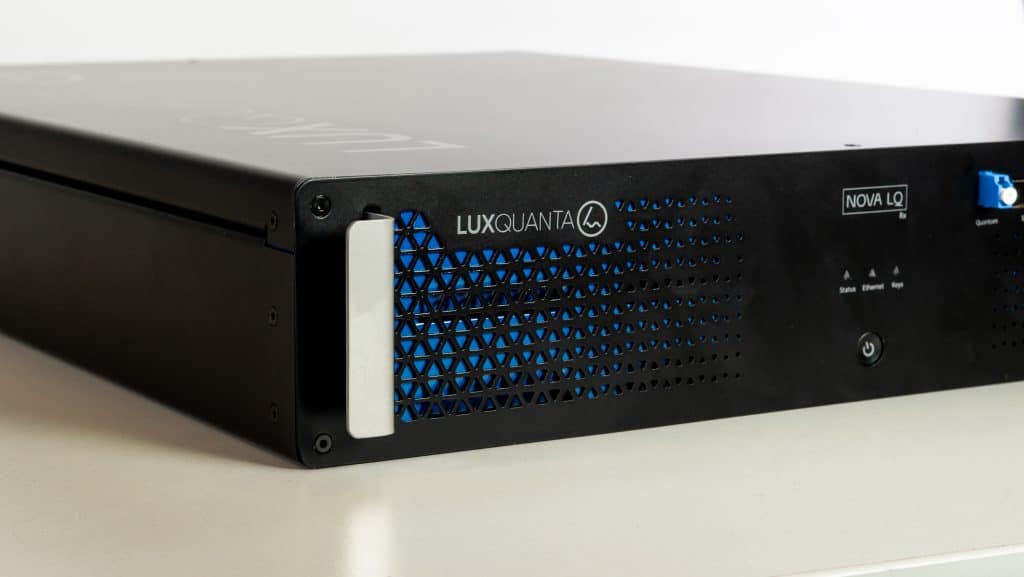
Development of a quantum communication unit with a robust, minimalist and distinctive design that represents the future of telecommunications security.
The quantum telecommunications industry is revolutionising the way we protect our most sensitive communications. LuxQuanta, a leading company in the field of quantum key distribution (QKD), is working on advanced technologies that will guarantee unprecedented levels of security. In this context, the design of the physical devices that make up these systems must convey trust, cutting-edge technology and a clear and distinctive identity.

NEEDS
A new design for a revolutionary technology.
The main challenge of the project was to redesign LuxQuanta’s quantum communication units, specifically its Q-Key device, to reflect the brand image and differentiate itself within a highly technical and emerging market.
Although the internal performance was already state-of-the-art, the device needed an external enclosure that projected technological solidity, visual minimalism and, at the same time, was coherent with LuxQuanta’s visual identity. The need to stand out from more established competitors made it essential to offer an innovative, clean and differentiating design.
PROCESS
Exploración estética y formal para un dispositivo tecnológico de alta complejidad.
1. Strategic analysis and positioning
The Stimulo team started the project by analysing the competitive context in which LuxQuanta finds itself. Opportunities for differentiation were identified through the formal language, the use of materials and finishes, as well as the configuration of the functional elements of the device.
Key design objectives:
– Reinforce LuxQuanta’s identity as a cutting-edge technology company.
– Create a robust, minimalist and attractive product.
– Facilitate its integration in professional telecommunication environments.

2. Design direction
After a first phase of conceptual exploration, several aesthetic directions were defined, combining minimalism with technological visual codes. A formal line was finally chosen that combined smooth, rounded surfaces on the sides with triangular patterns that provided dynamism and identity.
Major design decisions:
– Rounded side geometries for softness and fluidity.
– Triangular pattern on the lids to give the product an iconic and distinctive texture.
– Elegant integration of the ventilation system and connectors.

3. Iterations and validation
During the development phase, different design iterations, physical mock-ups and high quality (HQ) functional prototypes were made to validate both the aesthetics and technical feasibility of the proposed design.
Key challenges:
Achieve a balance between robust design and minimalist lines.
Ensure a high level of perceived quality in validation prototypes.
Adapt design to manufacturing and assembly needs without compromising aesthetics.

ValUE
Design as a differentiating element in an emerging market.
Although the product is not yet on the market, the new design of the Q-Key unit brings strategic value to LuxQuanta, positioning the brand as a leading technology company that takes care of both internal innovation and external projection.
Differentiation from the competition:
– Minimalist and distinctive design that stands out at trade fairs and presentations.
– Physical representation of the brand values: safety, precision and technology.
– Formal and aesthetic solutions adapted to the functional requirements of the device.
HUMAN FACTOR
Co-creation, trust and an iterative approach to build the future together.
Working closely with the LuxQuanta team was fundamental. During the four months of concept development, communication was constant and fluid, with more than two or three interactions per week.
Key Learnings:
One of the main lessons learned from the project was the importance of defining from the outset the expectations regarding prototypes and finishes, as this allows the team’s vision to be aligned with that of the client and avoid misunderstandings in later phases.
It was also key to properly structure the phases of the project, which allowed us to maintain a constant pace of work and meet the established deadlines without compromising the quality of the result. Finally, it became clear that we needed to constantly iterate with the client, combining technical and aesthetic inputs at each stage of the process, to ensure that the final solution met both the functional requirements and the desired visual identity.
Talent exchange
This project allowed both parties to learn from each other. LuxQuanta provided its technological and functional vision of the product, while Stimulo translated those needs into a visual language consistent with the brand.
Thanks to this exchange, an agile workflow was generated, in which changes and improvements were dynamically integrated, allowing for a constant evolution of the design without friction.
